• ERBuilder
  • Feature Matrix
  • Pricing
  • About us
  • ERBuilder Logo
  • 7.0
  • Getting started

    • About ERBuilder

    • Installation guide

    • User interface

  • Project management

    • Creating a new project

      • - Create a new project

      • - New project from scratch

      • - Automatically from user stories/ requirements

      • - From existing database

    • Opening an existing project

    • Closing a project

    • Saving a project

    • Save as a project

    • Exiting the application

    • Project properties

    • Opening multiple projects

  • Diagram Management

    • Add a new diagram

    • Delete a diagram

    • Rename a diagram

    • Diagram properties

    • Add existing tables/relationships to diagram

    • Show/hide relationships from a diagram

    • Export diagram as an image

    • Print/ Preview a diagram

    • Print setup

  • Objects

    • Tables

      • - Creating a new table

      • - Editing a table

      • - Deleting a table

      • - Duplicating a table

      • - Show/hide related relationships

      • - Table Styles

    • Domains

      • - Creating a new domain

      • - Editing an existing domain

      • - Deleting an existing domain

    • Columns

      • - Creating a new column

      • - Editing an existing column

      • - Deleting an existing column

    • Indexes

      • - Creating a new index

      • - Editing an existing index

      • - Deleting an existing index

    • Constraints

      • - Creating a new constraint

      • - Editing an existing constraint

      • - Deleting an existing constraint

    • Keys

      • - Creating a new key

      • - Editing an existing key

      • - Deleting an existing key

    • Triggers

      • - Creating a new trigger

      • - Editing an existing trigger

      • - Deleting an existing trigger

    • Procedures

      • - Creating a new procedure

      • - Editing an existing procedure

      • - Deleting an existing procedure

    • Views

      • - Creating a new view

      • - Editing an existing view

      • - Deleting an existing view

    • Sequences

      • - Creating a new Sequence

      • - Editing an existing Sequence

      • - Deleting an existing Sequence

    • Relationships

      • - Creating a new relationship

      • - Editing an existing relationship

      • - Deleting an existing relationship

      • - Setting relationship line style

      • - Add/ remove relationship point

      • - Show/hide a relationship

      • - Relationship styles

    • Schemas

      • - Creating a new Schema

      • - Editing an existing Schema

      • - Deleting an existing Schema

    • Requirements/ user stories

      • - Creating a new requirement/ user story

      • - Assign a requirement/ user story

      • - Editing an existing requirement/ user story

      • - Deleting an existing requirement/ story

      • - Import/ export requirements and user stories

    • Custom metadata

      • - Create a new custom metadata

      • - Assign a custom metadata

      • - Edit a custom metadata

      • - Delete a custom metadata

    • Manipulate objects

      • - Undo/Redo an action

      • - Copying/Pasting objects

      • - Reaching objects

      • - Organize and arrange Objects on a diagram

      • - Finding/Replacing objects

      • - Replacing data types

  • Connections management

    • Creating a new connection

    • Editing an existing connection

    • Deleting an existing connection

    • SSL settings

    • SSH settings

      • - SSH Connection using Password authentication

      • - SSH Connection using Public key authentication

    • Windows authentication

  • Forward/Reverse engineering

    • Forward engineering

      • - Model validation

      • - DDL Script generation

      • - Database generation

    • Reverse engineering an existing database

  • Advanced features

    • Update database from model

    • Update model from database

    • Generate change script

    • Compare models and/or databases

    • Merge models

    • Change DBMS

    • Model documentation

      • - Generate data model documentation

      • - Confluence connection settings

      • - Auto generate description

    • Generate data dictionary

    • Using ERBuilder console to generate documentation/ data dictionaries

    • Schedule the generation of data dictionaries/ documentation

    • Generate user interface

    • Generate test data

    • Data Generators settings

      • - Assign Data Generators

      • - Add a new generator template

    • Work with virtual test data in a database sandbox

    • Versions control management

  • Generative AI features

    • Auto-generate ERD using generative AI

    • Update model from Requirements/ User Stories using generative AI

    • Generative AI setup

  • Data model browser

    • About data model browser

    • Elements of the data model browser

    • Using the advanced filters

  • Git version control

    • Setup of Git with ERBuilder

    • Import project from Git repository

    • Save changes to Git repository

    • Refresh model

    • Manage versions

  • Options management

    • General

    • Diagram

    • Tables

    • Relationships

  1. Home
  2. Setup of Git with ERBuilder Data Modeler

Setup of Git with ERBuilder Data Modeler

The Git version control is a feature that enables you to work with Git for storing and sharing versioned data models. It provides a robust and easy way for collaboration and team working during the modeling process.
Before you start setting up a connection between ERBuilder data modeler and Git, you need to:

  • Install Git on your computer;
  • Have an account on Git;
  • Create a working repository and grant access to all the collaborators on your project.

To set-up a connection with your repository on Git, open ERBuilder data modeler then navigate to “Repository | Manage repository” and fill in the following information:

  • Remote repository: set path to your Git repository. To get the remote repository path, log in your Git account then navigate to the repository. Go to the “Code” dropdown button and open it, then copy the Https path.
  • Email: fill in your email
  • Name: fill in the Git user name
  • Git client: set path to your Git client
  • Branch: if you use the default branch “Master” leave this field empty. Otherwise, if you are using another branch, mention it here.
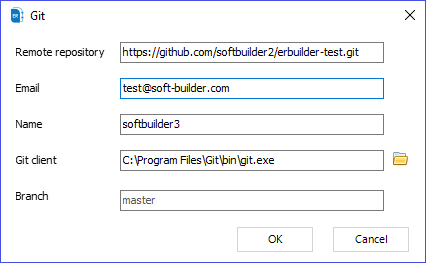
  • Setup of Git with ERBuilder Data Modeler


Available in: Enterprise Edition

  • ← Previous
  • Next →

Can't find what you're looking for?

Let us help you right now!

Version 7.0
Copyright © 2023 Softbuilder. All rights reserved.